Ditapis dengan
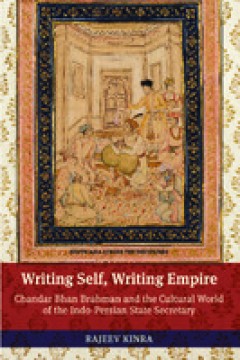
Writing self, writing empire :Chandar Bhan Brahman and the cultural world of …
"Writing Self, Writing Empire examines the life, career, and writings of the Mughal state secretary, or munshi, Chandar Bhan Brahman (d. ca. 1670), one of the great Indo-Persian poets and prose stylists of early modern South Asia. Chandar Bhan’s life spanned the reigns of four emperors: Akbar (1556–1605), Jahangir (1605–1627), Shah Jahan (1628–1658), and Aurangzeb ‘Alamgir (1658–170…
- Edisi
- -
- ISBN/ISSN
- 9780520961685
- Deskripsi Fisik
- XIX, 371 p.
- Judul Seri
- -
- No. Panggil
- 891.5512 KIN w
Critical studies in Indian grammarians I :the theory of homogeneity (Savarnya)
In the historical study of the Indian grammarian tradition, a line of demarcation can often be drawn between the conformity of a system with the well-known grammar of Pa?ini and the explanatory effectiveness of that system. One element of Pa?ini’s grammar that scholars have sometimes struggled to bring across this line of demarcation is the theory of homogeneity, or savar?ya, which concerns t…
- Edisi
- -
- ISBN/ISSN
- 9780472901708
- Deskripsi Fisik
- XIII, 224 p.
- Judul Seri
- -
- No. Panggil
- 491.4 DES c
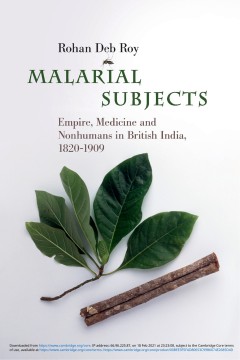
Malarial subjects :empire, medicine and nonhumans in British India, 1820-1909
Malaria was considered one of the most widespread disease-causing entities in the nineteenth century. It was associated with a variety of frailties far beyond fevers, ranging from idiocy to impotence. And yet, it was not a self-contained category. The reconsolidation of malaria as a diagnostic category during this period happened within a wider context in which cinchona plants and their most va…
- Edisi
- -
- ISBN/ISSN
- 9781316771617
- Deskripsi Fisik
- xv, 332p. : ill.
- Judul Seri
- -
- No. Panggil
- 616.936200954 ROY m
Health and wellbeing in late life :perspectives and narratives from India
This open access book takes a multidisciplinary approach to provide a holistic understanding of late old age, and situates the aged person within the context of family, caregivers, clinical and other institutions. All through the book, the author discusses preparedness for an aging individual as well as the society in the Indian context. The book highlights inevitable but mostly neglected healt…
- Edisi
- -
- ISBN/ISSN
- 9789811389382
- Deskripsi Fisik
- xxv, 195p. : ill.
- Judul Seri
- -
- No. Panggil
- 618.97 CHA h
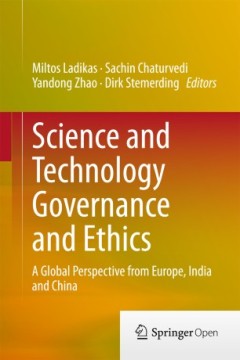
Science and technology governance and ethics :a global perspective from Europ…
This book analyzes the possibilities for effective global governance of science in Europe, India and China. Authors from the three regions join forces to explore how ethical concerns over new technologies can be incorporated into global science and technology policies. The first chapter introduces the topic, offering a global perspective on embedding ethics in science and technology policy. Cha…
- Edisi
- -
- ISBN/ISSN
- 9783319146935
- Deskripsi Fisik
- viii, 173p. : ill.
- Judul Seri
- -
- No. Panggil
- 509 MIL s
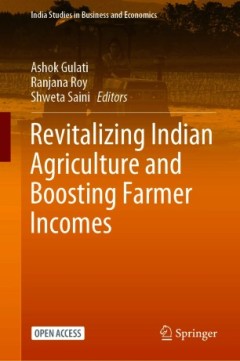
Revitalizing Indian agriculture and boosting farmer incomes
This open access book provides an evidence-based roadmap for revitalising Indian agriculture while ensuring that the growth process is efficient, inclusive, and sustainable, and results in sustained growth of farmers’ incomes. The book, instead of looking for global best practices and evaluating them to assess the possibility of replicating these domestically, looks inward at the best practic…
- Edisi
- -
- ISBN/ISSN
- 9789811593352
- Deskripsi Fisik
- xxii, 372p. : ill.
- Judul Seri
- -
- No. Panggil
- 338.10954 REV r
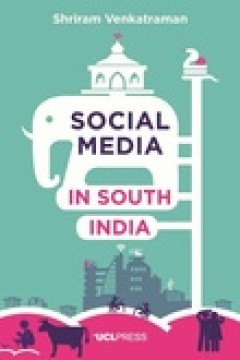
Social media in South India
One of the first ethnographic studies to explore use of social media in the everyday lives of people in Tamil Nadu, Social Media in South India provides an understanding of this subject in a region experiencing rapid transformation. The influx of IT companies over the past decade into what was once a space dominated by agriculture has resulted in a complex juxtaposition between an evolving know…
- Edisi
- -
- ISBN/ISSN
- 9781911307969
- Deskripsi Fisik
- 256 p.; 22 cm.
- Judul Seri
- -
- No. Panggil
- 302.2310954 VEN s
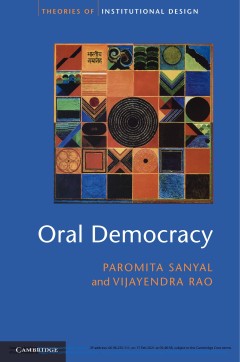
Oral democracy :deliberation in Indian village assemblies
Oral Democracy studies citizens' voices in civic and political deliberations in India's gram sabhas (village assemblies), the largest deliberative institution in human history. It analyses nearly three hundred transcripts of gram sabhas, sampled within the framework of a natural experiment, allowing the authors to study how state policy affects the quality of discourse, citizens' discursive per…
- Edisi
- -
- ISBN/ISSN
- 9781139095716
- Deskripsi Fisik
- xi, 215p. : ill.
- Judul Seri
- -
- No. Panggil
- 320.840954 SAN o
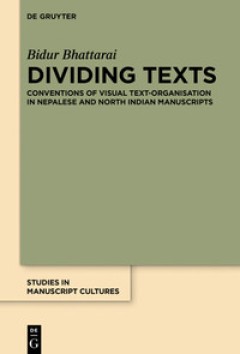
Dividing texts :conventions of visual text-organization in Nepalese and North…
The number of manuscripts produced in the Indian sub-continent is astounding and is the result of a massive enterprise that was carried out over a vast geographical area and over a vast stretch of time. Focusing mainly on areas of Northern India and Nepal between 800 to 1300 CE and on manuscripts containing Sanskrit texts, the present study investigates a fundamental and so far rarely studied a…
- Edisi
- -
- ISBN/ISSN
- 9783110543087
- Deskripsi Fisik
- XII, 376 p.
- Judul Seri
- -
- No. Panggil
- 091.0954960902 BHA d
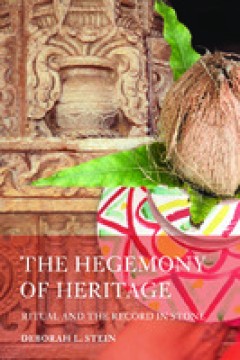
The hegemony of heritage :ritual and the record in stone
The Hegemony of Heritage makes an original and significant contribution to our understanding of how the relationship of architectural objects and societies to the built environment changes over time. Studying two surviving medieval monuments in southern Rajasthan—the Ambikā Temple in Jagat and the Śri Ékliṅgjī Temple Complex in Kailāshpurī—the author looks beyond their divergent sec…
- Edisi
- -
- ISBN/ISSN
- 9780520968882
- Deskripsi Fisik
- 338 p.
- Judul Seri
- -
- No. Panggil
- 720.954 STE h
 Karya Umum
  Filsafat
  Agama
Agama  Ilmu-ilmu Sosial
  Bahasa
  Ilmu-ilmu Murni
  Ilmu-ilmu Terapan
  Kesenian, Hiburan, dan Olahraga
  Kesusastraan
  Geografi dan Sejarah