Ditapis dengan
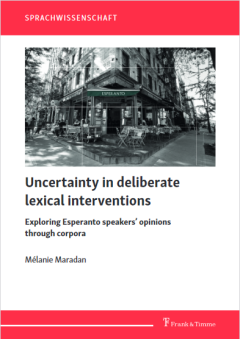
Uncertainty in deliberate lexical interventions:Exploring Esperanto speakersâ…
Language managers in their different forms (language planners, terminologists, professional neologists …) have long tried to intervene in the lexical usage of speakers, with various degrees of success: Some of their lexical items (partly) penetrate language use, others do not. Based on electronic networks of practice of the Esperanto speech community, Mélanie Maradan establishes the foundati…
- Edisi
- -
- ISBN/ISSN
- 9783732992379
- Deskripsi Fisik
- 373p.: ill.
- Judul Seri
- -
- No. Panggil
- 414 MAR u

Representations of transnational human trafficking :present-day news media, t…
This open access edited collection examines representations of human trafficking in media ranging from British and Serbian newspapers, British and Scandinavian crime novels, and a documentary series, and questions the extent to which these portrayals reflect the realities of trafficking. It tackles the problematic tendency to under-report particular types of victim and forms of trafficking, and…
- Edisi
- -
- ISBN/ISSN
- 9783319782140
- Deskripsi Fisik
- -
- Judul Seri
- -
- No. Panggil
- 401.41 REP r
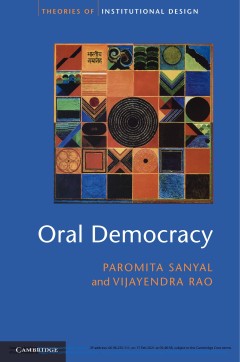
Oral democracy :deliberation in Indian village assemblies
Oral Democracy studies citizens' voices in civic and political deliberations in India's gram sabhas (village assemblies), the largest deliberative institution in human history. It analyses nearly three hundred transcripts of gram sabhas, sampled within the framework of a natural experiment, allowing the authors to study how state policy affects the quality of discourse, citizens' discursive per…
- Edisi
- -
- ISBN/ISSN
- 9781139095716
- Deskripsi Fisik
- xi, 215p. : ill.
- Judul Seri
- -
- No. Panggil
- 320.840954 SAN o
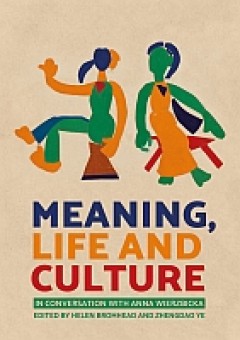
Meaning, life and culture :in conversation with Anna Wierzbicka
This book is dedicated to Anna Wierzbicka, one of the most influential and innovative linguists of her generation. Her work spans a number of disciplines, including anthropology, cultural psychology, cognitive science, philosophy and religious studies, as well as her home base of linguistics. She is best known for the Natural Semantic Metalanguage (NSM) approach to meaning—a versatile tool fo…
- Edisi
- -
- ISBN/ISSN
- 9781760463939
- Deskripsi Fisik
- XVIII, 515 p.
- Judul Seri
- -
- No. Panggil
- 801.4 MEA m
 Karya Umum
  Filsafat
  Agama
Agama  Ilmu-ilmu Sosial
  Bahasa
  Ilmu-ilmu Murni
  Ilmu-ilmu Terapan
  Kesenian, Hiburan, dan Olahraga
  Kesusastraan
  Geografi dan Sejarah