Ditapis dengan
Implementing responsible research and innovation :organisational and national…
The book is an analysis of data collected in the RRI-Practice study. It comprises an organizational analysis and an analysis of national discourses, thus analysing conditions for the uptake of RRI in research funding and research performing organisations in the science system.
- Edisi
- -
- ISBN/ISSN
- 9783030578503
- Deskripsi Fisik
- xix, 120p. : ill.
- Judul Seri
- -
- No. Panggil
- 174.95 IMP i

Competing knowledges – wissen im widerstreit
Whatever societies accept as ‘knowledge’ is embedded in epistemological, institutional, political, and economic power relations. How is knowledge produced under such circumstances? What is the difference between general knowledge and the sciences? Can there be science without universal truth claims? Questions like these are discussed in eleven essays from the perspective of Sociology, Law, …
- Edisi
- -
- ISBN/ISSN
- 9783110659658
- Deskripsi Fisik
- X, 220 p.
- Judul Seri
- -
- No. Panggil
- 121 COM c
Digital transformation of learning organizations
This open access volume provides insight into how organizations change through the adoption of digital technologies. Opportunities and challenges for individuals as well as the organization are addressed. It features four major themes: 1. Current research exploring the theoretical underpinnings of digital transformation of organizations. 2. Insights into available digital technologies as well a…
- Edisi
- -
- ISBN/ISSN
- 9783030558789
- Deskripsi Fisik
- xxi, 252p. : ill.
- Judul Seri
- -
- No. Panggil
- 658.406 DIG d
Life and technology:an inquiry into and beyond Simondon
The philosophy of Gilbert Simondon has reinvigorated contemporary thinking about biological and technological beings. In this book, Jean-Hugues Barthélémy takes up Simondon’s thought and shows how life and technology are connected by a transversal theme: individuation. In the first essay, Barthélémy delivers a contemporary interpretation of Simondon’s concept of ontogenesis against the …
- Edisi
- -
- ISBN/ISSN
- 9783957960702
- Deskripsi Fisik
- 173 p.; 23 cm.
- Judul Seri
- -
- No. Panggil
- 194 BAR l

Why be moral?
What reasons do we have to be moral, and are these reasons more compelling than the reasons we have to pursue non-moral projects? Ever since the Sophists first raised this question, it has been a focal point of debate. Why be Moral? is a collection of new essays on this fundamental philosophical problem, written by an international team of leading scholars in the field.
- Edisi
- -
- ISBN/ISSN
- 9783110366396
- Deskripsi Fisik
- VIII, 278 p.
- Judul Seri
- -
- No. Panggil
- 170 WHY w

Agroecology now! :transformations towards more just and sustainable food systems
This open access book develops a framework for advancing agroecology transformations focusing on power, politics and governance. It explores the potential of agroecology as a sustainable and socially just alternative to today’s dominant food regime. Agroecology is an ecological approach to farming that addresses climate change and biodiversity loss while contributing to the Sustainable Develo…
- Edisi
- -
- ISBN/ISSN
- 9783030613150
- Deskripsi Fisik
- xiv, 199p. : ill.
- Judul Seri
- -
- No. Panggil
- 630.277 AGR a

The democracy of objects
In The Democracy of Objects Bryant proposes that we break with the epistemological tradition and once again initiate the project of ontology as first philosophy. Bryant develops a realist ontology, called -onticology-, which argues that being is composed entirely of objects, properties, and relations. Bryant proposes that objects are dynamic systems that relate to the world under conditions of …
- Edisi
- -
- ISBN/ISSN
- 9781607852049
- Deskripsi Fisik
- 1 online resource
- Judul Seri
- -
- No. Panggil
- 150.92 LEV d
Public Policy:Why ethics matters
Ethics is a vigorously contested field. There are many competing moral frameworks, and different views about how normative considerations should inform the art and craft of governmental policy making. What is not in dispute, however, is that ethics matters. The ethical framework adopted by policy analysts and decision makers not only shapes how policy problems are defined, framed and analysed, …
- Edisi
- -
- ISBN/ISSN
- 9781921666759
- Deskripsi Fisik
- -
- Judul Seri
- -
- No. Panggil
- 170 BOS p
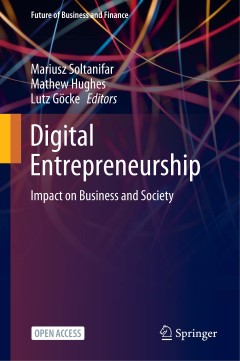
Digital entrepreneurship :impact on business and society
This open access book explores the global challenges and experiences related to digital entrepreneurial activities, using carefully selected examples from leading companies and economies that shape world business today and tomorrow. Digital entrepreneurship and the companies steering it have an enormous global impact; they promise to transform the business world and change the way we communicat…
- Edisi
- -
- ISBN/ISSN
- 9783030539146
- Deskripsi Fisik
- xxiv, 327p. : ill.
- Judul Seri
- -
- No. Panggil
- 658.421 DIG d
Value and the humanities the neoliberal university and our victorian inheritance
Tracing the shift from liberal to neoliberal education from the nineteenth century to the present day, this open access book provides a rich and previously underdeveloped narrative of value in higher education in England. Value and the Humanities draws upon historical, financial, and critical debates concerning educational and cultural policy. Rather than writing a singular defence of the human…
- Edisi
- -
- ISBN/ISSN
- 9783030378929
- Deskripsi Fisik
- 255 p.; 22 cm.
- Judul Seri
- -
- No. Panggil
- 171.2 VAL v
 Karya Umum
  Filsafat
  Agama
Agama  Ilmu-ilmu Sosial
  Bahasa
  Ilmu-ilmu Murni
  Ilmu-ilmu Terapan
  Kesenian, Hiburan, dan Olahraga
  Kesusastraan
  Geografi dan Sejarah