Ditapis dengan
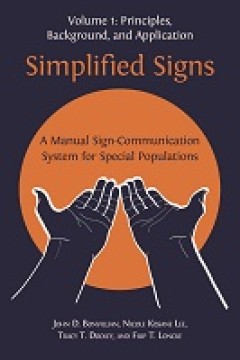
Simplified sign:a manual sign-communication system for special populations, v…
Simplified Signs presents a system of manual sign communication intended for special populations who have had limited success mastering spoken or full sign languages. It is the culmination of over twenty years of research and development by the authors. The Simplified Sign System has been developed and tested for ease of sign comprehension, memorization, and formation by limiting the complexity…
- Edisi
- -
- ISBN/ISSN
- 9781783749263
- Deskripsi Fisik
- -
- Judul Seri
- -
- No. Panggil
- 419 BON s
Expressions of Austronesian thought and emotions
This collection of papers is the seventh volume in the Comparative Austronesian series. The papers in this volume focus on societies from Sumatra to Melanesia and examine the expression and patterning of Austronesian thought and emotions.
- Edisi
- -
- ISBN/ISSN
- 9781760461911
- Deskripsi Fisik
- 210 p.; 22 cm.
- Judul Seri
- -
- No. Panggil
- 499.2 EXP e
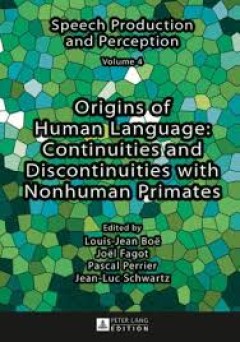
Origins of human language:continuities and discontinuities with nonhuman prim…
This book proposes a detailed picture of the continuities and ruptures between communication in primates and language in humans. It explores a diversity of perspectives on the origins of language, including a fine description of vocal communication in animals, mainly in monkeys and apes, but also in birds, the study of vocal tract anatomy and cortical control of the vocal productions in monkeys…
- Edisi
- -
- ISBN/ISSN
- 9783631737262(hardcover)
- Deskripsi Fisik
- 365 pages ; 22 cm.
- Judul Seri
- -
- No. Panggil
- 401 ORI o
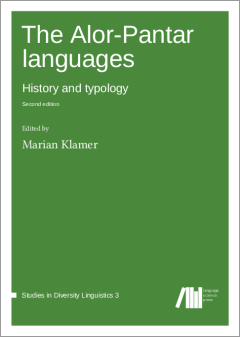
The Alor-Pantar languages:history and typology. Second edition.
The Alor-Pantar family constitutes the westernmost outlier group of Papuan (Non-Austronesian) languages. Its twenty or so languages are spoken on the islands of Alor and Pantar, located just north of Timor, in eastern Indonesia. Together with the Papuan languages of Timor, they make up the Timor-Alor-Pantar family. The languages average 5,000 speakers and are under pressure from the local Mala…
- Edisi
- -
- ISBN/ISSN
- 9783961100224
- Deskripsi Fisik
- 509 p.; 23 cm.
- Judul Seri
- -
- No. Panggil
- 499.12 KLA a

Uncertainty in deliberate lexical interventions:Exploring Esperanto speakersâ…
Language managers in their different forms (language planners, terminologists, professional neologists …) have long tried to intervene in the lexical usage of speakers, with various degrees of success: Some of their lexical items (partly) penetrate language use, others do not. Based on electronic networks of practice of the Esperanto speech community, Mélanie Maradan establishes the foundati…
- Edisi
- -
- ISBN/ISSN
- 9783732992379
- Deskripsi Fisik
- 373p.: ill.
- Judul Seri
- -
- No. Panggil
- 414 MAR u

Introduction to old Javanese language and literature :a kawi prose anthology
The oldest and most extensive written language of Southeast Asia is Old Javanese, or Kawi. It is the oldest language in terms of written records, and the most extensive in the number and variety of its texts. Javanese literature has taken many forms. At various times, prose stories, sung poetry or other metrical types, chronicles, scientific, legal, and philosophical treatises, prayers, chants,…
- Edisi
- -
- ISBN/ISSN
- 9780472902187
- Deskripsi Fisik
- XII, 151 p.
- Judul Seri
- -
- No. Panggil
- 499.222 ZUR i
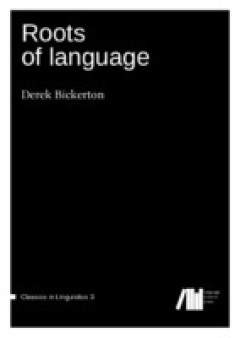
Roots of language
Roots of language was originally published in 1981 by Karoma Press (Ann Arbor). It was the first work to systematically develop a theory first suggested by Coelho in the late nineteenth century: that the creation of creole languages somehow reflected universal properties of language. The book also proposed that the same set of properties would be found to emerge in normal first-language acquisi…
- Edisi
- -
- ISBN/ISSN
- 9783946234081
- Deskripsi Fisik
- xiii, 284 p.; 22 cm.
- Judul Seri
- -
- No. Panggil
- 401 BIC r
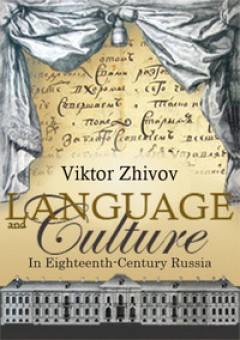
Language and culture in eighteenth century Russia
Victor Zhivov's Language and Culture in Eighteenth-Century Russia is one of the most important studies ever published on eighteenth-century Russia. Historians and students of Russian culture agree that the creation of a Russian literary language was key to the formation of a modern secular culture, and this title traces the growth of a vernacular language from the "hybrid Slavonic" of the late …
- Edisi
- -
- ISBN/ISSN
- 9781618116734
- Deskripsi Fisik
- XVII, 506 p.
- Judul Seri
- -
- No. Panggil
- 491.709033 ZHI l
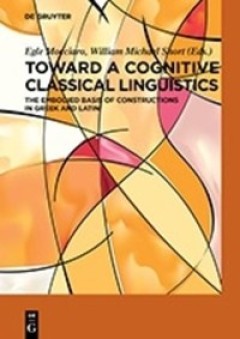
Toward a cognitive classical linguistics :he embodied basis of constructions …
This volume gathers a series of papers that bring the study of grammatical and syntactic constructions in Greek and Latin under the perspective of theories of embodied meaning developed in cognitive linguistics. Building on the momentum currently enjoyed by cognitive-functional approaches to language within the field of Classics, its contributors adopt, in particular, a ‘constructional’ app…
- Edisi
- -
- ISBN/ISSN
- 9783110616347
- Deskripsi Fisik
- VIII, 273 p.
- Judul Seri
- -
- No. Panggil
- 480 MOC t

Rating EFL written performance
The study focuses on the investigation of the process during which raters of EFL written performance make their decisions. It consists of a pilot and a main study, each of which concentrates on assessment of writing. The rationale is to detect the decision-making processes that raters follow, which can be used for training raters, and with which the reliability of rating can be improved. The pi…
- Edisi
- -
- ISBN/ISSN
- 9788376560793
- Deskripsi Fisik
- 424 p.
- Judul Seri
- -
- No. Panggil
- 428.0071 BUK r
 Karya Umum
  Filsafat
  Agama
Agama  Ilmu-ilmu Sosial
  Bahasa
  Ilmu-ilmu Murni
  Ilmu-ilmu Terapan
  Kesenian, Hiburan, dan Olahraga
  Kesusastraan
  Geografi dan Sejarah