Ditapis dengan
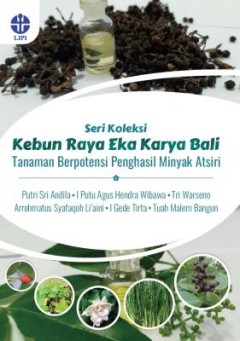
Seri koleksi kebun raya eka karya Bali tanaman berpotensi penghasil minyak at…
Minyak atsiri, atau yang juga popular dengan nama essential oil, sangat terkenal dengan ciri khas aromatik yang kuat. Manfaatnya pun juga sangat banyak, mulai dari antiseptik, analgesik, antidepresi, hingga antijamur. Oleh karena itu, tidak mengherankan jika minyak yang bersifat volatil ini umum digunakan di berbagai bidang industri dan telah menjadi komoditas yang bernilai ekonomi tinggi. P…
- Edisi
- -
- ISBN/ISSN
- 9786024961800
- Deskripsi Fisik
- xvi, 128 hal.; ill. 21 cm
- Judul Seri
- -
- No. Panggil
- 582.12 AND s

Anisotropy across fields and scales
This open access book focuses on processing, modeling, and visualization of anisotropy information, which are often addressed by employing sophisticated mathematical constructs such as tensors and other higher-order descriptors. It also discusses adaptations of such constructs to problems encountered in seemingly dissimilar areas of medical imaging, physical sciences, and engineering. Featuring…
- Edisi
- -
- ISBN/ISSN
- 9783030562151
- Deskripsi Fisik
- x, 280p. : ill.
- Judul Seri
- -
- No. Panggil
- 515.63 ANI a

Mosquitopia :the place of pests in a healthy world
This edited volume brings together natural scientists, social scientists and humanists to assess if (or how) we may begin to coexist harmoniously with the mosquito. The mosquito is humanity’s deadliest animal, killing over a million people each year by transmitting malaria, yellow fever, Zika and several other diseases. Yet of the 3,500 species of mosquito on Earth, only a few dozen of them a…
- Edisi
- -
- ISBN/ISSN
- 9781003056034
- Deskripsi Fisik
- xxi, 290p.: ill.
- Judul Seri
- -
- No. Panggil
- 595.772 MOS m
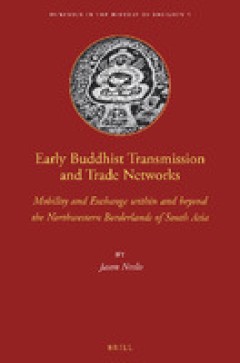
Early Buddhist Transmission and Trade Networks :Mobility and Exchange Within …
This book examines catalysts for Buddhist formation in ancient South Asia and expansion throughout and beyond the northwestern Indian subcontinent to Central Asia by investigating symbiotic relationships between networks of religious mobility and trade.
- Edisi
- -
- ISBN/ISSN
- 9789004194588
- Deskripsi Fisik
- XVIII, 371 p.
- Judul Seri
- -
- No. Panggil
- 294.37209021 NEE e
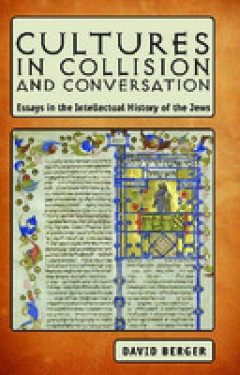
Cultures in Collision and Conversation :Essays in the Intellectual History of…
In Cultures in Collision and Conversation, David Berger addresses three broad themes in Jewish intellectual history: Jewish approaches to cultures external to Judaism and the controversies triggered by this issue in medieval and modern times; the impact of Christian challenges and differing philosophical orientations on Jewish interpretation of the Bible; and Messianic visions, movements, and d…
- Edisi
- -
- ISBN/ISSN
- 9781618117915
- Deskripsi Fisik
- XIII, 367 p.
- Judul Seri
- -
- No. Panggil
- 296.39 BER c

Paths :Why is life filled with so many detours?
This open access book explores the amazing similarity between paths taken by people and many other things in life, and its impact on the way we live, teach and learn. Offering insights into the new scientific field of paths as part of the science of networks, it entertainingly describes the universal nature of paths in large networked structures. It also shows the amazing similarity in the w…
- Edisi
- -
- ISBN/ISSN
- 9783030475451
- Deskripsi Fisik
- xxv, 86p. : ill.
- Judul Seri
- -
- No. Panggil
- 511.5 GUL p
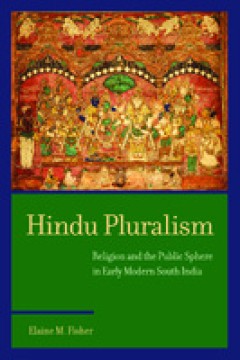
Hindu Pluralism:Religion and the Public Sphere in Early Modern South India
In Hindu Pluralism, Elaine M. Fisher complicates the traditional scholarly narrative of the unification of Hinduism. By calling into question the colonial categories implicit in the term “sectarianism,” Fisher’s work excavates the pluralistic textures of precolonial Hinduism in the centuries prior to British intervention. Drawing on previously unpublished sources in Sanskrit, Tamil, and T…
- Edisi
- -
- ISBN/ISSN
- 9780520966291
- Deskripsi Fisik
- XI, 300 p.
- Judul Seri
- -
- No. Panggil
- 294.509548 FIS h
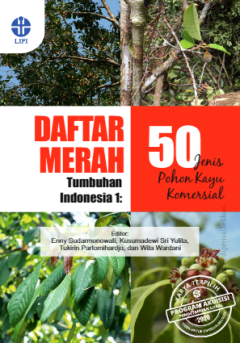
Daftar merah tumbuhan Indonesia 1:50 jenis pohon kayu komersial
Jenis kayu komersial pernah menjadi sumber penghasil devisa penting bagi Indonesia. Kayu-kayu komersial, terutama yang mendominasi hutan dataran rendah, telah mengalami perubahan alih fungsi lahan yang begitu cepat sejak tiga dekade lalu sehingga mengakibatkan menurunnya habitat dan populasi alam. Apabila tidak segera dilakukan aksi konservasi yang nyata, jenis-jenis tersebut bisa punah dalam w…
- Edisi
- -
- ISBN/ISSN
- 9786024960964
- Deskripsi Fisik
- xvi, 75 p. ; 21 cm.
- Judul Seri
- -
- No. Panggil
- 575.46598 SUD d
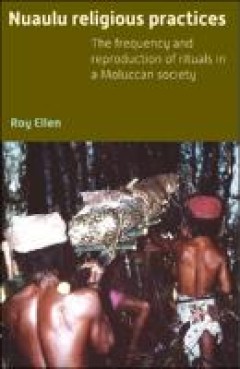
Nuaulu Religious Practices :The frequency and reproduction of rituals in a Mo…
How religious practices are reproduced has become a major theoretical issue. This work examines data on Nuaulu ritual performances collected over a 30 year period, comparing different categories of event in terms of frequency and periodicity. It seeks to identify the influencing factors and the consequences for continuity. Such an approach enables a focus on related issues: variation in perform…
- Edisi
- -
- ISBN/ISSN
- 9789004253452
- Deskripsi Fisik
- xxviii, 356 p.
- Judul Seri
- -
- No. Panggil
- 299.9222 ELL n
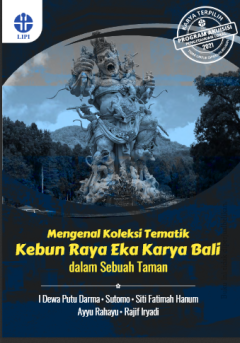
Mengenal koleksi tematik kebun raya eka karya bali dalam sebuah taman
Kebun Raya Eka Karya Bali merupakan salah satu kebun raya yang dikelola oleh Pusat Penelitian Konservasi Tumbuhan dan Kebun Raya, Lembaga Ilmu Pengetahuan Indonesia (PPKTR-LIPI). Terletak di kawasan dataran tinggi Bedugul, kebun raya ini menjanjikan pemandangan alam yang sangat indah disertai dengan udara sejuk khas pegunungan. Koleksi tumbuhan dari dataran tinggi kering dan kawasan timur Indon…
- Edisi
- -
- ISBN/ISSN
- 9786024961954
- Deskripsi Fisik
- xix, 124 p, ; 21 cm
- Judul Seri
- -
- No. Panggil
- 580.73 DAR m
 Karya Umum
  Filsafat
  Agama
Agama  Ilmu-ilmu Sosial
  Bahasa
  Ilmu-ilmu Murni
  Ilmu-ilmu Terapan
  Kesenian, Hiburan, dan Olahraga
  Kesusastraan
  Geografi dan Sejarah